Presented at the
40th Annual General Body Meeting of NCDFI
Honourable members,
With great pleasure, I welcome
you all to the fortieth annual general meeting of NCDFI. May I now present
before you the Annual Report and the Audited Statement of Accounts of your
federation for the year 2009-10.
Report on Operations:
During the year 2009-10, the
NCDFI continued to coordinate marketing of milk, milk products and frozen semen
doses. The highlights include:
Coordination with Ministry of
Defence
Fresh Milk:
NCDFI coordinated supply of
about 5.81 crore litres of liquid milk valued at about Rs.131 crore from the
cooperative dairies to about 163 Defence units which include ASC Depots, Air
Force Stations and Military Farms under the Ministry of Defence (MoD).
Butter Fresh:
NCDFI coordinated supply of
about 530 MT Butter Fresh valued at about Rs.10 crore from the cooperative
dairies to about 163 Defence units which include ASC Depots, Air Force Stations
and Military Farms under the MoD.
UHT Milk:
NCDFI coordinated supply of
about 3.41 crore litres of UHT (Tetrapak) Milk to 68 Defence units in Eastern,
Western, Northern and Southern Commands valued at about Rs.124 crores.
Milk Products:
During the year, supply of
about 5511 MT of milk products valued at about Rs.74 crores was coordinated by
the NCDFI on behalf of its members to the MoD. The products supplied include
1000 MT Whole Milk Powder, 390 MT Butter Tinned, 446 MT Ghee, 405 MT Cheese
Tinned, 2470 MT Malted Milk Food and 800 MT Sweetened Condensed Milk.
Coordination with Railway Board
/ IRCTC
Allotment of milk parlours:
Since 2005,
NCDFI has been working in coordination with the Railway Board / Indian Railway
Catering and Tourism Corporation (IRCTC) for allotment of parlours at railway
platforms to the dairy cooperatives. The move has two objectives; first – to
make available quality milk products at reasonable prices for consumption of
railway commuters and second – to provide much needed boost to the milk
cooperatives to expand their market. As on March 31, 2010, IRCTC awarded 715
stalls to various milk cooperative federations / unions. Out of this only 406
stalls have become operational. Therefore, our member cooperatives have to make
necessary efforts in making the allotted stalls operational.
Milk and milk product
supplies: I am
happy to inform that IRCTC accorded its approval for supply of milk and milk
products by NCDFI/member organizations on experimental basis for a period of six
months starting from July 21, 2009. During the year, member organizations have
supplied milk and milk products to IRCTC base kitchens and pantry cars under
this arrangement. Now IRCTC has extended this arrangement for a further period
of six months. With the support of member organizations, I am sure that we will
make this arrangement successful and have a long term association with IRCTC in
providing quality milk products to railway passengers.
Marketing of Frozen Semen Doses
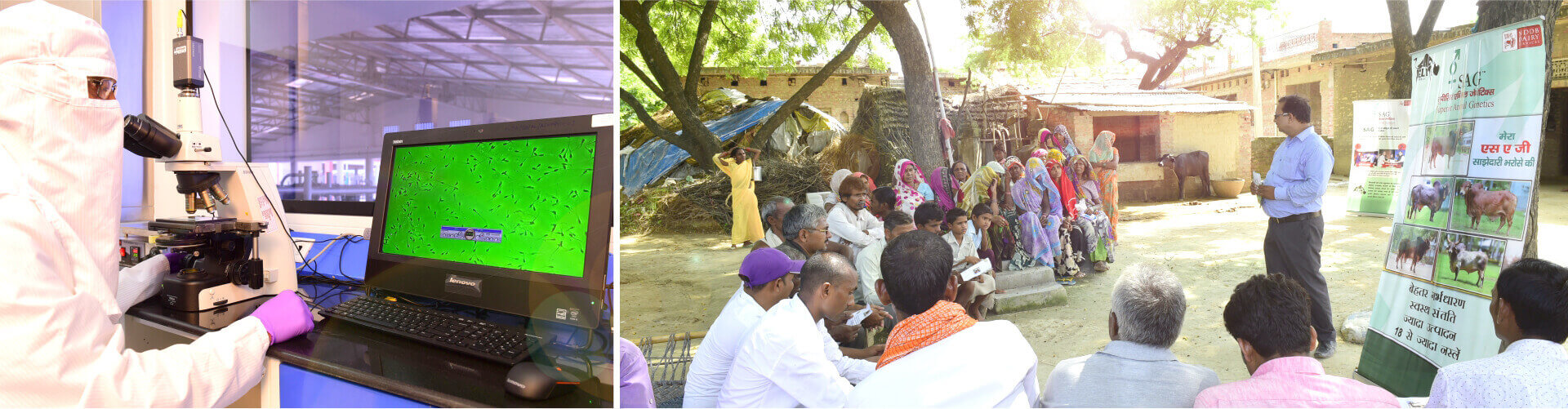
With a view to make available
good quality semen doses to the milk producers in the country, NCDFI has been
functioning as ‘carrying and forwarding agency’ of Frozen Semen Doses (FSDs) and
embryos produced by Sabarmati Ashram Gaushala, Bidaj (SAGB) and Animal Breeding
Centre, Salon (ABC). Both these organisations function under the technical
guidance of National Dairy Development Board (NDDB).
The Central Monitoring
Committee constituted by the Government of India awarded ‘A’ Grade to both SAGB
and ABC sperm stations. Both SAGB and ABC are the most modern Semen Production
Stations in the country with most sophisticated semen processing equipment to
produce frozen semen adhering to stringent quality control tests. Both these
farms are accredited with ISO 9001:2000 certification for production, processing
and supply of FSDs.
To promote the FSD sales, NCDFI
organized a stall at Animal Husbandry Fair at Guru Angad Dev Veterinary and
Animal Science University, Ludhiana in March 2010. During the year 2009-10,
NCDFI coordinated sale of 118 lakh FSDs produced by SAGB and ABC which is 13.4%
higher compared to the previous year. Further, during the year NCDFI coordinated
exports of FSDs and embryos produced by SAGB to UAE and Nepal.
Cooperative Advocacy
India has become the world's
largest milk producing nation. Despite of achieving this, India is set to face
milk shortage due to low productivity and rising consumption in both rural and
urban areas. Demand for milk in the country is increasing at much faster rate
than its production. High cost of feed and fodder increased the cost of milk
production. Many of our milk producers are women and most of whom are landless,
small and marginal farmers. For achieving the noble cause of rural upliftment
through cooperative dairy development and to check the milk prices in the
country, it is important that the Government should have policies that
facilitate dairy development. Recently, our dairy cooperatives and the NCDFI had
made a strong plea to the Government to consider the following policy changes.
Income tax:
Dairy cooperatives follow multi-tier structure – at the bottom, village level
primary dairy cooperatives societies; at district / Tehsil level, milk
processing unions; and at the state level state cooperative marketing dairy
federations. Village level primary cooperative societies form a milk union at
district level to process their milk in a plant. Similarly, district level milk
unions federate into a state level milk marketing federation for efficient
marketing of their produce. On a closer look, you will find that these
cooperatives are working for the same purpose i.e. maximizing return for milk
producers by adding value in different ways in the whole value chain. Presently,
the primary dairy cooperative societies at village level are exempt from payment
of income tax. However, the district level cooperatives are taxed. As all these
cooperatives are performing similar functions they need to be treated on equal
footings and be exempted from payment of income tax. This will provide
additional benefit to the milk producers through better prices and services.
Imposing export duty on oil
cakes: Oil
cakes and rice bran constitute an important component of livestock feed. Large
scale export of oil cake resulted in shortage and it fuelled the domestic prices
of cakes. Hence, India should discourage export of oil cakes to control the
rising prices which affect cattle feed cost resulting in increasing the cost of
production of milk.
Applicability of taxes:
Different states
have prescribed different rates of VAT on various dairy products and
machineries. For example, some States have levied VAT at 12.5 per cent on ghee,
as against 4 per cent on edible oil. Pasteurized and sterilized milk (packed or
vended) on all dairy products and all machineries employed in their preparation
should be charged VAT either at 0 per cent or at the most 4 per cent. Further,
Government of India should prevail upon all the States to remove all taxes
including mandi tax, purchase tax, etc. to mitigate hardships faced by the dairy
industry and allow them to compete with the global players.
Export subsidies on meat:
Currently all
cow and buffalo meat exporters get 30% subsidy on exports. Due to this subsidy,
meat exports have doubled in last four years. There is a need to reverse the
anti-dairy development cycle where the best of milch cattle and their calves are
used for slaughter for short term gains. This is making milch animals scarce and
thereby causing reduction in production of milk. Hence, Government of India
needs to remove subsidies on meat exports.
Acknowledgement
I would like to specially thank
the millions of our milk producers and oilseeds growers who are the grassroot
members of cooperatives affiliated to NCDFI. They continue to provide the
support to the NCDFI’s activities.
I gratefully acknowledge the
continuing support we receive from the National Dairy Development Board.
I am grateful to the Institute
of Rural Management, Sabarmati Ashram Gaushala and Animal Breeding Centre for
their help and cooperation.
I would like to thank the
Government of India, especially the Ministry of Agriculture, the Ministry of
Defence, the Ministry of Home Affairs, the Ministry of Railways, the Railway
Board and the Indian Railway Catering and Tourism Corporation (IRCTC) for their
help and support.
I would like to convey special
thanks to Chairmen and Chief Executives of our member federations who have
actively participated in the different meetings of NCDFI. They have always
provided their valuable support.
I am thankful to state Animal
Husbandry Departments, dairy cooperatives, self employed veterinarians, NGOs,
and LSS workers who continue to avail frozen semen manufactured at SAGB and ABC.
My thanks to our Bankers and
Auditors for the services rendered by them.
A note of
appreciation for the officers and staff of NCDFI, it is through their hard work
and devotion, that, NCDFI could carry out its activities smoothly during the
year.
Thank you,
On behalf of the Board of Directors
Sd/-
(Vinayakrao D Patil)
Chairman